Manufacturing stringed instruments in France
Part 1: The development of industrial production in Mirecourt
An artisan's sense of accomplishment - at least professionally speaking - is not necessarily a question of achieving perfection with uniquely successful pieces, but often merely in finding a happy medium. With this thought in mind, Didier l‘Ainé Nicolas initiated a new era of violin making in his hometown of Mirecourt in the late 18th century. Rather than concentrate on premium instruments (which he was perfectly capable of crafting), he chose to create affordable violins with a powerful sound. The craftsman standards of these instruments were simpler, yet they still offered his clients the musical properties they sought. The national and international success he soon enjoyed confirmed his strategy: in 1802 he was the first instrument maker from Mirecourt to take part in an exhibition, and in 1806 he received a silver medal at a show in Paris. More important than these milestone dates, however, was the fact that in the later years of his life, his factory employed some 600 people, making his business the first large-scale operation of its kind in the tradition-rich town in northern France's Vosges mountains.
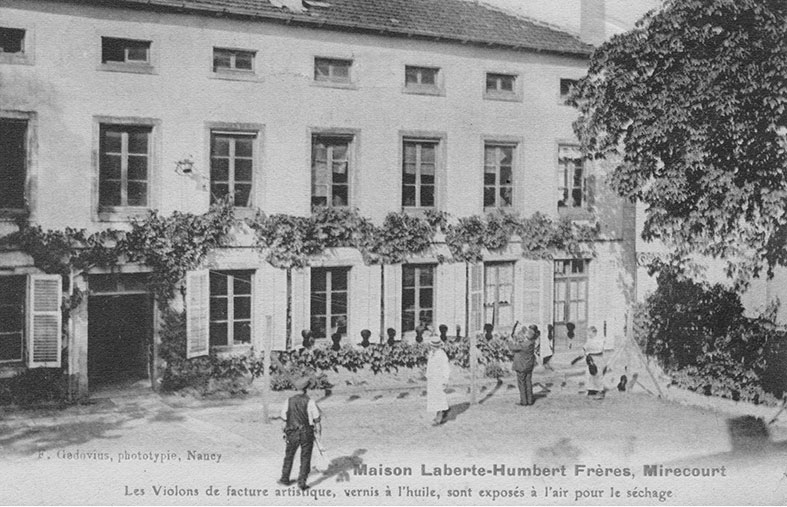
Didier Nicolas was Mirecourt's local example of a change which slowly evolved in other European violin-making centres of the day. The customary form of the craft – an art which was never entirely abandoned – was still being passed from masters to journeymen, especially within the family. But alongside this tradition, mass production emerged as well, which met a constantly growing and widespread demand. A piecework approach to making instruments was soon followed by mechanically supported production, and while this did not guarantee excellent quality, it did yield reliable products and supplanted the individual work of a master with an identifiable and more marketable profile of an instrument series. Maintaining branch offices in larger cities, especially (and obviously) Paris, as well as international trade connections helped secure the sales of these musical instruments which were manufactured in huge numbers.
By no means was Didier Nicolas' factory the apex of the expanding industrialization of violin making, however. A look back on this period, which lasted into the late 1960s, shows that three main companies must be mentioned as the key figures which shaped French violin making and represented Mirecourt around the world: Jérôme Thibouville-Lamy and two family businesses,
Laberte and Couesnon.
Related articles:
Markneukirchen: violin making at the crossroads of craftsmanship and trade
Mirecourt: French violin making
Contemporary violin makers from China and Taiwan
J.T.L. - Jérôme Thibouville-Lamy
Couesnon: The third defining element in modern violin making in Mirecourt
Morizot, père et frères: the short history of a great family of bow makers
Charles Nicolas Bazin: the great name of Mirecourt bow making
Bazin's grandchildren: bow making in turbulent times
Concours Vatelot -- the important French violin making contest
Mirecourt's new masters: contemporary violin makers in Mirecourt